Progress can feel exciting at first. You add a few reps, lift a little more or notice everyday tasks getting easier. Then, for a while, the numbers stop moving.
A plateau is a normal part of getting stronger. It doesn’t mean you’ve failed, and it doesn’t automatically mean you need a brand-new programme or a heavier weight. Often, the answer is to look at how you’re progressing, and whether you’re measuring it fairly.
Progressive overload isn’t “add weight every time”
Progressive overload means gradually asking your body to meet a changing training challenge. Adding weight is one way to do that, but it’s not the only one.
You might also progress by:
- Completing another repetition with the same load
- Using a slightly more challenging exercise variation
- Building up to an extra set when it makes sense for your plan
- Increasing your comfortable range of motion
- Improving control and consistency
- Practising a movement more regularly, if your plan supports it
A small study comparing load and repetition progressions found that both could be viable ways to make progress over an eight-week training period. That doesn’t mean every method suits every goal or person. It does show that the weight on the dumbbell isn’t the only useful measure. You can read the research paper for more detail.
The goal isn’t to make every session harder. It’s to build a repeatable challenge you can recover from and gradually develop.
The myth of perfect form
“Perfect form” can sound like there’s one ideal way every person must move. Real bodies differ. Your proportions, mobility, experience, equipment and training history all matter, so a squat or press may look a little different from one person to another.
That doesn’t mean technique doesn’t matter. It means a useful technique standard should help you move with control, use a suitable range and repeat the exercise in a way that works for you, not force you into someone else’s exact shape.

Think of technique as your movement standard. For a given exercise, aim for a comfortable, repeatable setup and range of motion. Use a load you can manage without needing to rush, bounce or change the movement just to finish a rep.
A rep that looks a little different from a fitness video isn’t automatically wrong. But if you need to shorten your range sharply, twist to get through the lift or ignore worsening pain, that’s a sign to pause and reassess. Better to adjust the exercise than to chase a number at any cost.
Try a simple progression: reps first, then load
A practical method is to work within a repetition range. Let’s say your plan prescribes 3 sets of 8–12 reps for an exercise.
- Choose a load you can lift for at least eight controlled reps.
- Keep that load the same while gradually building your reps.
- Once you can complete 12 reps on all three sets with a consistent movement standard, consider a small increase in load.
- Start again nearer the lower end of the rep range.
For example, if you perform 3 sets of 8, 9 and 8 reps this week, you could aim for one more rep on one or more sets next time. You don’t have to force it. If you reach 12, 12 and 12 comfortably, a modest weight increase may be the next step.
If you train at home with limited weights, progression can still happen. You could add a rep, use a harder variation, or improve your range where comfortable. Our guide to strength training at home with minimal equipment has ideas for building a routine with what you have.
Track the right things
It’s hard to spot progress when you’re relying on memory. Keep a simple record of your exercise, load, sets and reps. Add a short note if your range, setup or how the session felt was different.

Your records help answer useful questions:
- Did you use the same weight and exercise variation?
- Did you complete more reps, or make the same reps feel more controlled?
- Was your range of motion comparable?
- Were you unusually tired or short on time?
- Has this happened for one session, or several weeks?
A single off day is not necessarily a plateau. Look for a pattern across several sessions, and check that you’re comparing like with like. A slightly heavier lift with a very different range or setup may not tell you as much as it seems.
Stuck? Check the basics before changing everything
When progress slows, it’s tempting to swap every exercise or add more sets straight away. First, look for the simplest explanation.
1. Is your plan consistent?
If your exercise or rep scheme changes every week, it can be difficult to see whether you’re improving. Give a sensible plan enough time to show you a trend.
2. Are you recovering?
Poor sleep, a stressful week or doing more training than you can recover from may affect how strong you feel. More work isn’t always the answer. If your performance has dipped across several exercises and you feel run down, your plan may need a lighter spell or more recovery.
3. Is the movement still comfortable?
If a familiar exercise starts to feel uncomfortable, don’t treat that as a challenge to push through. Reduce the load, try a more suitable variation or stop if symptoms worsen. Our guide to injury-aware home training explains ways to make considered adjustments. Ongoing or worrying pain deserves advice from an appropriate healthcare professional; an app or general guide can’t diagnose an injury.
4. Change one thing at a time
If your movement feels consistent and recovery is reasonable, try one small adjustment: build reps, make a modest load change, or review your exercise choice. Changing several things at once makes it harder to tell what helped.
Let your plan adapt with you
A useful workout planner app should do more than hand you a template. It should help you keep track of what you’re doing and give you a clear next step when your routine needs attention.
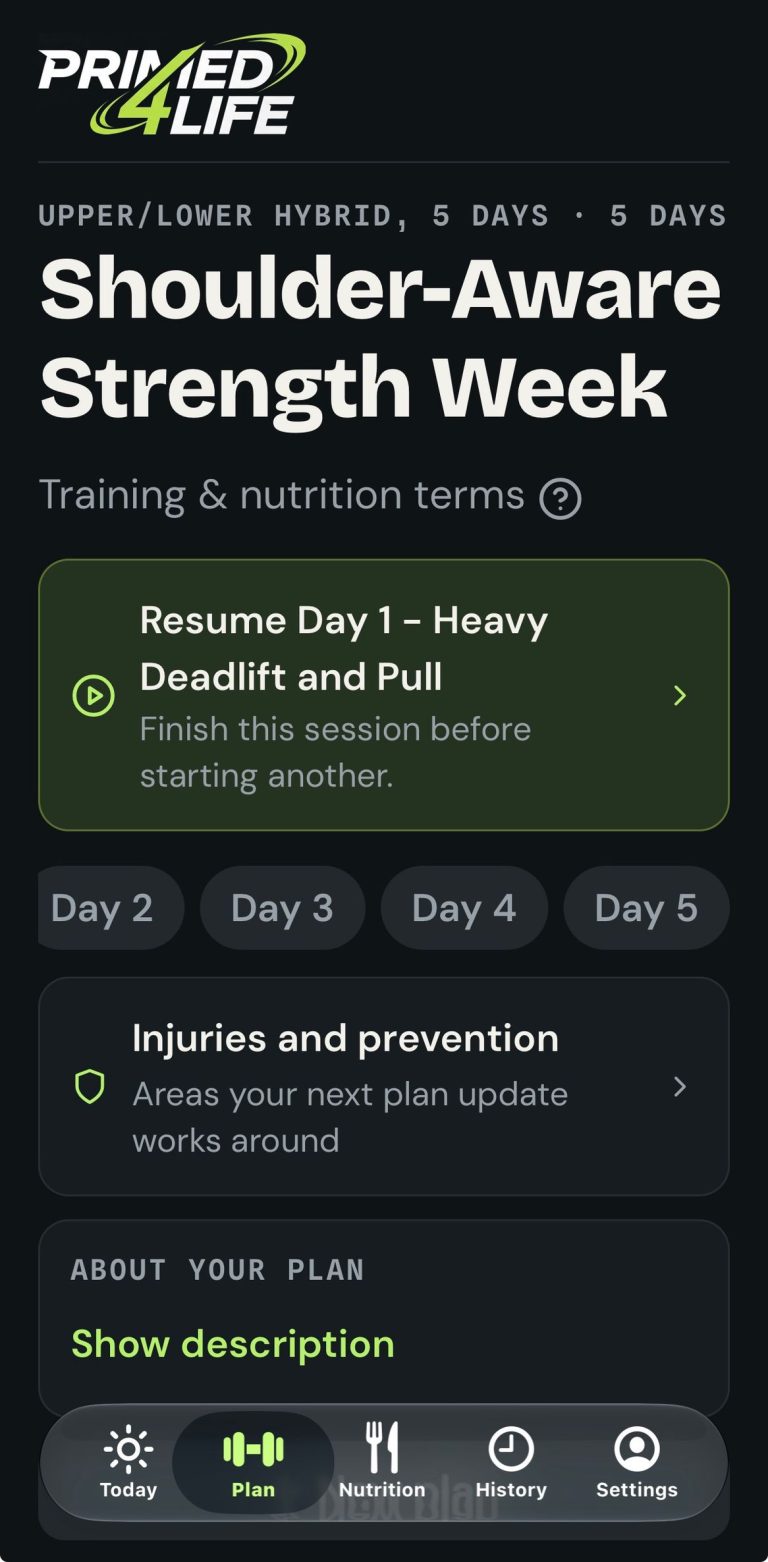
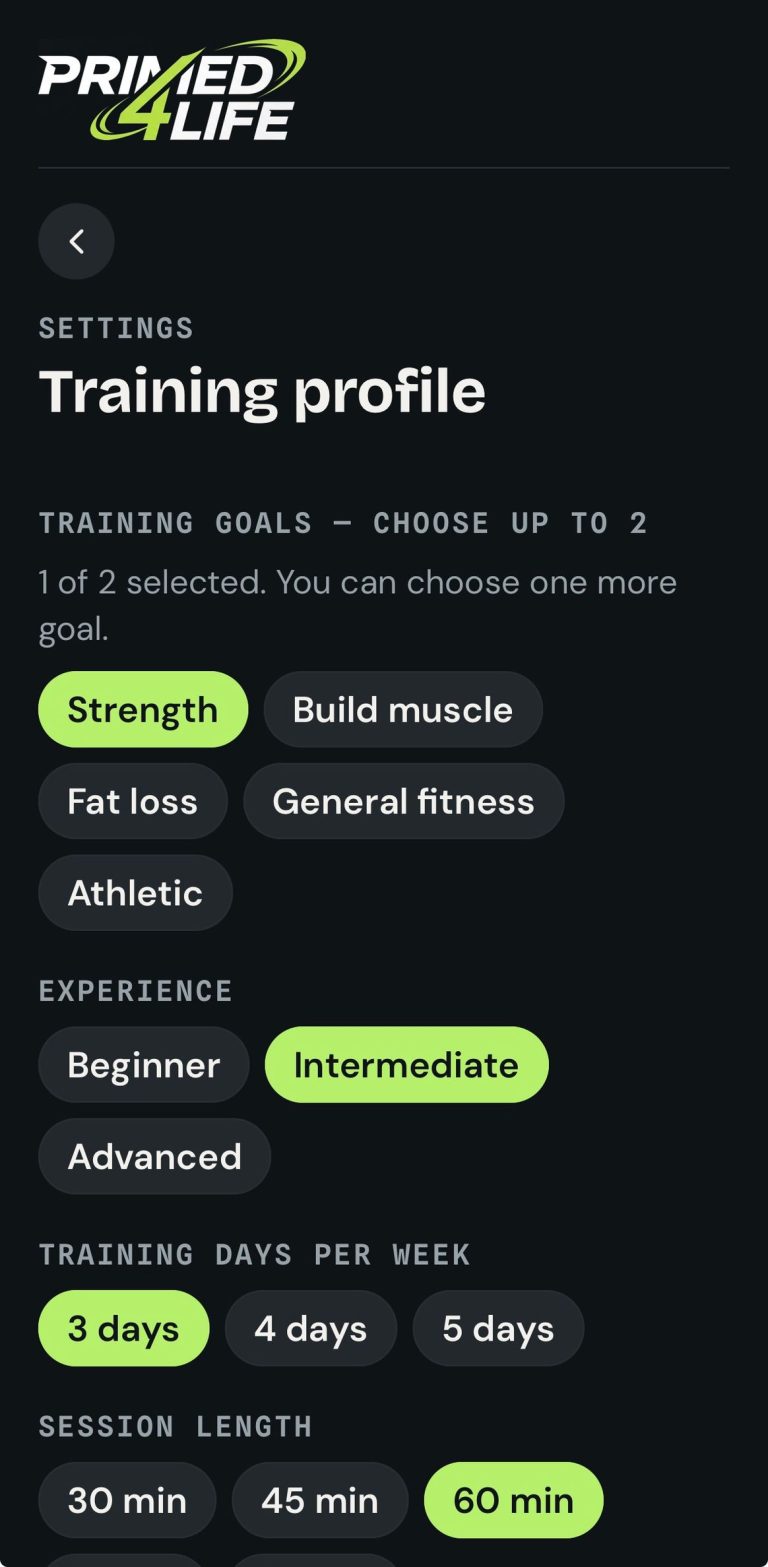
Primed4Life creates training plans around your goals, experience, available equipment and training days. Your sessions include exercises, sets, reps, rest periods and technique videos, with progression built into the plan. It’s an AI-led strength training app, with an AI specialist available to answer questions about your training, technique, food and recovery. If you’d like one-to-one support, you can upgrade to work with a human coach.
Your plan doesn’t need to change every time you have a slow session. With weekly check-ins, your training and food logs help inform feedback about what’s working and what you might try next. You choose whether to generate an adjusted plan or keep your current one.
That means an exercise planner app can support structure without taking away your choice. Train in a gym, at home with dumbbells or with bodyweight movements. Start where you are, and build from there.
Keep progressing, without chasing perfect
Progressive overload works best when it’s gradual, trackable and suited to you. Add a rep before you rush to add weight. Use a repeatable technique standard, not a mythical perfect pose. And when your numbers stall, look at the bigger picture before deciding you need to do more.
Ready for a plan that helps you make those choices? Start with your first training and nutrition plans free at Primed4Life. Your setup takes about three minutes, and your next step can fit the equipment, experience and schedule you already have.
Your first plan is free
Get a training plan and 7-day nutrition plan built around your goals, equipment and any injuries.